This story originally appeared in North Valley News.
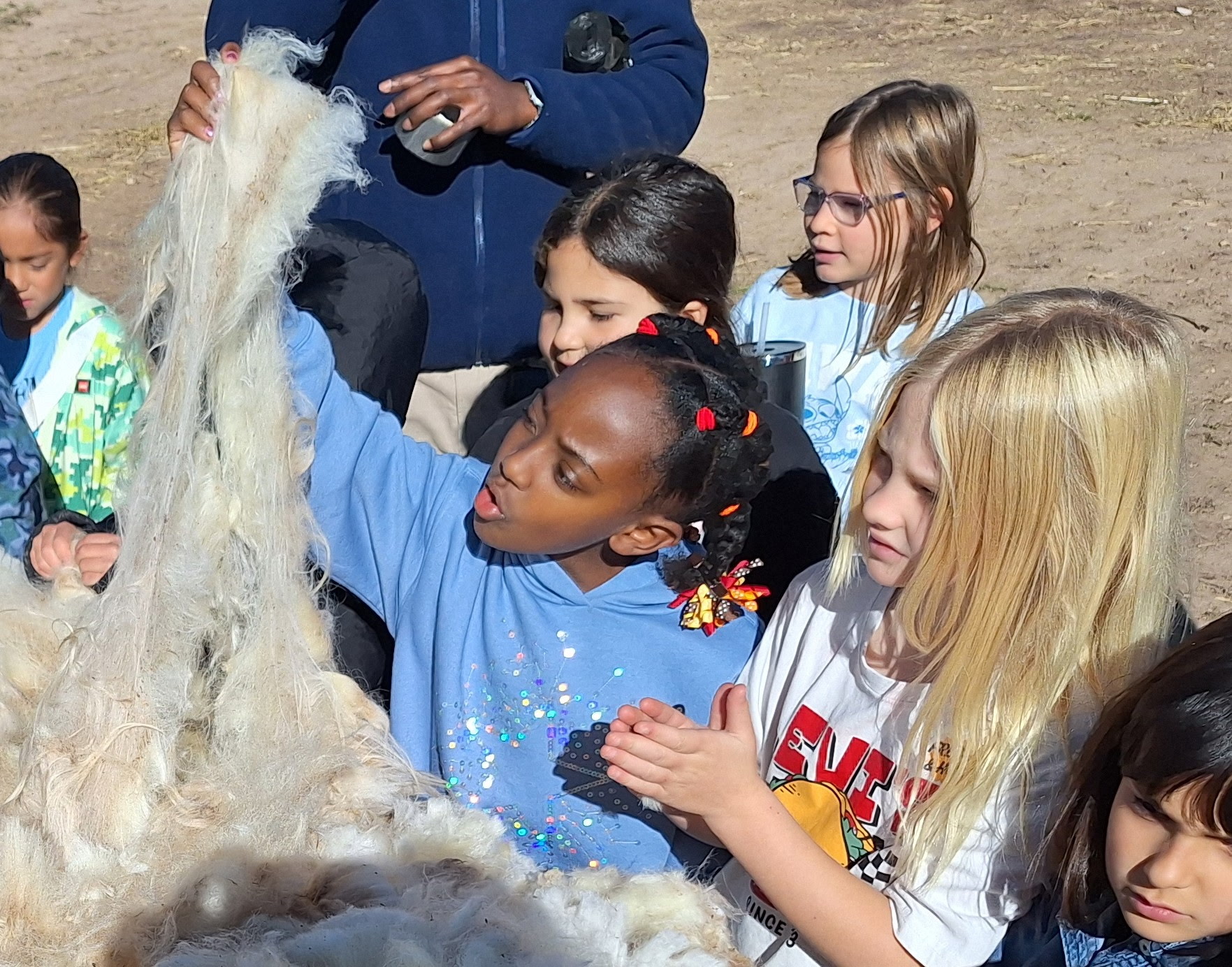
On a brisk November morning, a group of kids from Alvarado Elementary School gathered at a fence at the Agri-Nature Center, completely focused on a sheep shearing demonstration. A few minutes later, they excitedly rushed over to a small table to feel the freshly cut wool with their own hands.
The group of second- and third-graders walks over to the center once a month during the school year, participating in activities such as crop planting and wool bead making to learn about different agriculture and nature subjects firsthand.
“I like being able to feel the wool,” said 8-year-old Maxine, who added that she enjoys learning new things on field trips. She hadn’t ever been to a farm before visiting the Agri-Nature Center with her class.
Other students shared similar enthusiasm. Averi, 7, who also had never been to a farm before these field trips, said she enjoyed seeing nature. Sofia, 7, and Anika, 9, said they like interacting with the farm’s dogs, and Charlie, 7, said he liked getting an up-close look at the freshly sheared wool.
Meanwhile, 8-year-old Kathryn said she liked that she and her classmates sometimes got to keep souvenirs from their field trips. For instance, each kid took a small bit of wool from the sheep-shearing event, which they’ll use to make beads back in the classroom.
Their teacher Laura Richards said these field trips, which begin and end with an approximately 20-minute trek along the Griegos Drain, are “really healthy for them.”
“They love to walk,” she said. “When we’re walking, they talk to me in ways that they don’t get to have access to in the classroom. So they’ll open up about stuff. They get dirty. They kind of seem more engaged. They’re more excited. They just seem happier. When we get back from the walk, they’re refreshed and they’re ready.”
The nature class is in its second year at Alvarado. During their visits to the Agri-Nature Center, students have participated in a variety of activities, including soil blocking—a seed-starting method that replaces traditional plastic pots and cell trays with self-supporting, compressed cubes of seed-starting mix. They planted onion seeds in the blocks and got to see those sprout in the greenhouse before planting them in outdoor garden plots and eventually harvesting mature onions.
“So they got to kind of see that full cycle of growing and how much energy and work goes into it,” Richards said.
Students have also gardened at the Rio Grande Community Farm and have learned about fermenting and pickling food, composting, and more, during nature class.
According to Farm Manager Andy Thran, the key to holding kids’ interest is incorporating hands-on activities into their visits.
“When they come out here, if you just try to talk about the values of cover cropping, even with the seventh-graders, they don’t care. Like, at all,” he said. “But if you can get kids down in the soil and be like, ‘Hey, let’s look for some bugs,’ or, ‘Let’s dig some carrots,’ or, ‘Let’s make some wool beads,’ or, ‘Plant some seeds,’ then you can talk while you work.”
Alvarado isn’t the only area school taking advantage of outdoor learning opportunities at the Agri-Nature Center. This fall, the Bosque School brought its seventh-graders to complete a service program, and fifth graders from Coronado K-8 Dual Language Magnet School walked to the farm, where they wrote in nature journals, made wool beads and toured the market garden.
Richards said taking her students outdoors helps to balance the technology that is commonly used in classrooms today. Activities such as the sheep-shearing demonstration can even help connect students with their heritage.
“A lot of these kids are culturally from this area,” she says. “Historically, their families used to do things like this, so it connects to their culture and to their language. We have a lot of kids who are Navajo or Diné, and for the first time they’re learning about Navajo-Churro sheep. And so even though I’m explaining it to them, they are connecting to their past in a way too, which is kind of cool.”